
The Beginning And The End Of The Universe
Despite humanity researching for years and years about space, being able to map out an entire observable universe from simple telescopes, and identifying countless celestial bodies around us, there is so much we still don't know about the universe around us.
For example, how did it start? The most accepted answer is The Big Bang, an event that is theorized to have happened around 13.8 billion years ago, when nothingness became a universe, all in a giant explosion that released more energy than we can comprehend.
And what about the universe's end? Will it end in fire? In ice? Will Black Holes swallow the entirety of the Universe? Or will it contract in on itself, and explode again? We don't know, and there's more things we don't know too.

Dark Matter and Dark Energy
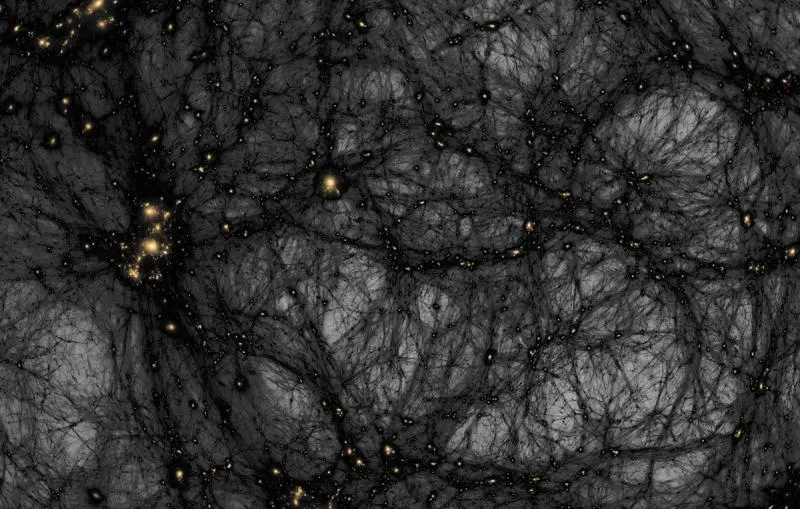
What takes up the majority of space anyways? Between stars and galaxies and other things. There's no air in space, so what's really floating in the endless vacuum? We have dubbed this mystery material "Dark Matter". It does not emit, reflect, or absorb light, but it exerts strong gravitational forces that hold everything in the universe, like galaxies, together. Without Dark Matter, we'd fly clean off into the void!
Another mystery is the universe itself is still expanding! But from what energy? Is it residual from the Big Bang? Is something even more massive driving it? This phenomenon is driven from what we call "Dark Energy", an invisible force that drives celestial entities further and further from each other, expanding the universe faster and faster as time goes on.
Odd Celestial Bodies
Let's dive into some smaller, mysterious celestial bodies with no explanation behind their interesting quirks.
Tabby's Star is an F-type star in the Cygnus constellation that appears to dim at random times, sometimes as low as only 22% brightness! We have no idea how a star can even dim itself to this level. While stars can dim their light, due to pulsation or by an excess of gas in their atmospheres, Tabby's Star dims WAY too much for it to be explained as of the moment.
Then there's Oumuamua, an unexplained long rocky object that entered our Solar System from the Lyra constellation. However, its speed wasn't being affected nor pulled by any known gravitational force, leading scientists to make theories as to why it was so fast, yet unaffected by the Sun's gravity. The leading theory involves that Oumuamua used to have ice, which melted near the Sun, giving it a boost from the hydrogen gasses released. However, it's still only a theory.


Weird Cosmic Events
Then there's cosmic events still not fully explained by confirmed hypotheses, like FRBs and ORCs.
FRBs, short for Fast Radio Bursts, are intensely bright, split-second flashes of radio waves originating from mysterious distant galaxies. The origin and cause of these bursts is still largely unknown, the largest hypothesis seems to be from a Black Hole or Pulsar.
ORCs, short for Odd Radio Circles, are circles of radiation forming out of an unexplained phenomenon. In total, there are 8 such ORCs that have been discovered (and possibly, 6 more), invisible to the naked eye, but are visible on radio wavelengths. They appear as green rings, some even doubled. And a few surround galaxies, which might be how ORCs are formed, but it's still a mystery.
Fermi Bubbles
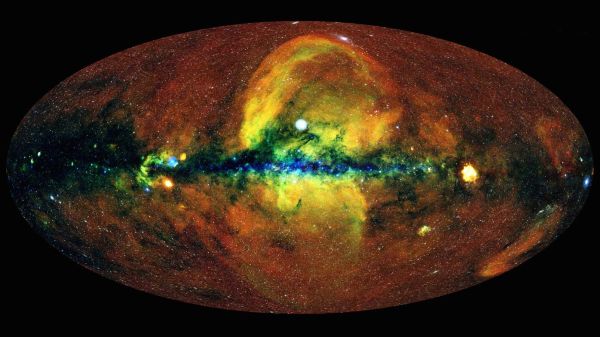
In 2010, the Fermi Telescope observed large gamma-ray "bubbles" that stretched across the sky. Now called the "Fermi Bubbles" these high-energy gamma ray areas sit above and below the flat plane of our Milky Way Galaxy, spanning a total length of around 50,000 light years.
It's unknown what exactly created these bubbles, or why they emit so much more gamma radiation than even our own galaxy, however, it may be related to the Supermassive Black Hole at the center of the Milky Way, Sagittarius A.
Supermassive Black Holes that ingest lots of matter can power high-energy "jets" of radiation, so it's possible Sagittarius A went through that process in the past, and these bubbles might be the result of which. However, it's still a theory, we don't know exactly how the bubbles came to be.

The 1977 "Wow!" Signal
On August 15th, 1977, the Ohio State University's "Big Ear" radio telescope detected a 72-second long narrow-band radio signal. It seemed to stem from the Sagittarius constellation, and from an unknown exact location. The "Wow!" was written next to the computer printout of the anomaly, by a very surprised astronomer, leading to the signal's claim to fame.
Several theories and explanations have risen as to where the signal could come from, including a special star called a "Magnetar", a kind of star that has a fast rotation and a very strong magnetic field. This combination can result in "star quakes", like an earthquake, but in a star. It releases a TON of energy into space, which might be where the signal could have come from.
However, the actual reason behind the "Wow!" it still unknown, as the signal only happened once, only for those 72 seconds, and has never happened again since.