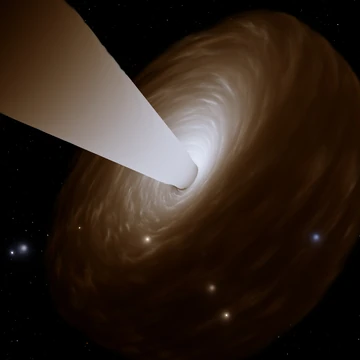
Black Holes of Different Sizes
Sometimes when a dying star collapses, in place of becoming a superdense Neutron Star, it turns into a massive, incredibly dense void that stretches and swallows anything that comes close to it. Not even light can escape it, making these Black Holes... black!
Black Holes are certainly something to behold, and like any other celestial body, they come in a variety of sizes. Stellar Black Holes can range from a few to hundreds of times the Sun’s mass, while Supermassive Black Holes are much, MUCH larger, being several hundreds of thousands of times more massive.
The grey area between the Stellar and Supermassive Black Holes are home to Intermediate Black Holes, which are still being debated in the size department. Quasar Black Holes are extremely luminous, active galactic centers powered by Supermassive Black Holes millions or billions the mass of the Sun.


Primordial Black Holes???
There may have been a time where even LARGER Black Holes made their homes in the early Universe, nicknamed Primordial Black Holes.
These hypothesized Black Holes may have only existed for a fraction of a moment, right after the Big Bang, then vanished just as quickly. But who knows, maybe there's a Primordial Black Hole somewhere in the Universe even now...
Sagittarius A
Black Holes have a lot of mass, meaning they're not only very heavy and dense, they also have a lot of gravity. THis gravity pulls things towards them, collecting entire galaxies around some Supermassive Black Holes. Even our Milky Way galaxy has a Supermassive Black Hole in it's center, named Sagittarius A.
Located around 26,000 Light Years away, it's the closest Supermassive Black Hole to Earth, and it anchors the entire Milky Way galaxy together, keeping it stable instead of everything being flung all over empty space.


Notable Black Holes
Other notable Black Holes include a very popular Black Hole, named M87, located in the Messier 87 galaxy around 55 million light years away. It was the first Black Hole to be photographed, taken in 2019 by the Event Horizon Telescope.
There's also Cygnus X-1, discovered in 1971 and the first object identified to be widely accepted as a Black Hole.
The closest known Black Hole, albeit not Supermassive, is a Black Hole only around 1,560 light years away from Earth in the Ophiuchus constellation named Gaia BH1.
The Biggest Of Them All
But what's the BIGGEST Black Hole we know of? It's still a debated topic, with new celestial bodies being discovered every day. However, the most accepted answer is a Supermassive Black Hole located around 18.2 billion light years from Earth, around the constellation "Canes Venatici" (or "The Hunting Dogs").
This Supermassive Black Hole is named "Tonantzintla 618", or TON 618 for short. (If you want to say the long name, it's pronounced: "toh-nahn-TSEENT-lah")It's a Hyper-luminous Quasar, with an estimated mass of around 40.7-66 BILLION times more than our Sun, and around 240 billion miles/400 billion kilometers wide! Now THAT's big!